
Sibley & Pitman

Clarence Clifford Sibley was born in Bennington, Vermont in 1864 the youngest of 4 brothers. He received his early education there and afterwards, graduated from Williams College, MA in 1885. By 1902, in his mid-30s, he married Nannie Markoe and started a family. Of their three sons and two daughters, none are known to have followed in similar careers as their father. The family were living in Perth Amboy, New Jersey.
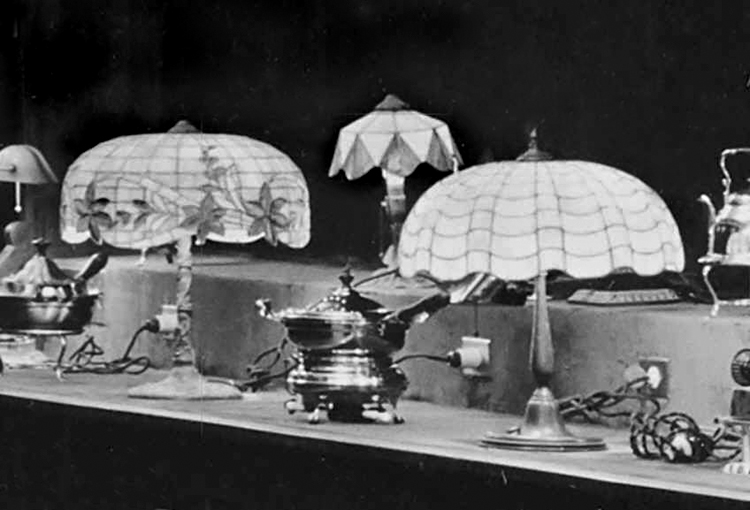
Sibley & Pitman were already in business by the time Amboy Works was incorporated in 1906 with a substantial $50,000 investment. George D. Pitman was his business partner, but little is currently known about him beyond his role as company secretary and treasurer. Speculation suggests that the manufacture of leaded glass lighting could have been prompted by an agreement to supply shades to Reed & Barton. However, S&P more likely invested in Amboy Works to produce their own line of leaded lamps in response to burgeoning public demand. It is clear that Amboy Works simply became one of several business endeavours of Sibley & Pitman. In addition to the leaded lamps in the photographs taken in 1913 of the their lamps at their New York agency on West 36th Street, household appliances and accessories are also on display. Another photo from the same year was published by the New York Edison Company in their trade journal. This extraordinary photo features over 40 models of S&P's leaded lamp line inside the S&P showroom.
An electrical engineer and manufacturer by trade, Sibley was awarded numerous international patents for lighting components. One example included the design of an incandescent lamp socket. This was met with some success and the firm had plans to take this to market.
During the East Coast's shift toward domestic electricity, Sibley’s interests in the stained glass market expanded beyond Amboy Works. In 1907, he was named President of the newly incorporated Clark Art Glass Company in New York. This coincided with the end of the long-standing agency relationship between S.B. and C.B. Clark and the Unique Art Glass & Metal Co. By early 1908, trade journals reported that this new Clark Art Glass firm was manufacturing lamps for the brothers. Considering Amboy Works was in full swing by 1907, it is possible that Clark Art Glass served as a New York outlet for Amboy’s production. This arrangement appears to have been short-lived; following the Clark brothers' 1909 bankruptcy, Clark Art Glass was renamed as Standard Glass & Bronze Company.
Sibley was extremely active not only in business ventures, but civic appointments too. In 1909, he became president of the Board of Health in Perth Amboy. Also, he held the position of water commissioner and sat on the board of that utility. From evidence in the press, 1913 saw Sibley offer to sell the Amboy Works to the Water Board. This marks the probable end of his involvement in and demise of his leaded lamps business. Sibley continued his business activities into the early 1920s, growing his business around a vast array of electrical appliances and accessories.
He held close relationships with GE until, in August of 1924, he died unexpectedly in New York whilst on his way to work. He was 59 years old. Photos of Sibley were recently discovered in the college's archives and appear on this website courtesy of Williams.
Lighting Manufacturers in Perth Amboy
The 1907-1915 period in Perth Amboy's history saw a chaotic time in the stained glass industry, driven by urgency to capitalize on the lighting boom. Small firms rose and fell rapidly, on occasion sharing resources and craftspeople for production.
Building upon Peter Lyons' discovery of Amboy Works within the Reed & Barton archives at Harvard, more research has turned up 3 additional firms warranting examination. They are Antique Mosaic Glass Works, Art Nouveau Shade Works, and Sterling Brass & Bronze Works. Starter pages have been created from period press reports, ancestry data and family contact. All will require updates as new information comes to light.
Amboy Works - Chapman Arrives
The reader may recall that after Waldo Chapman prematurely left his degree course at Harvard University around 1902, he had a short engagement working with Richard Chandler's company on Congress Street in Boston. Among other shade suppliers to Reed & Barton was Benjamin Priest who acquired Chapman's business. So, it's possible that Chapman's indirect relationship with Reed & Barton was probably established before Benjamin Priest's brief engagement with them.
After his time with Chandler, Chapman met and subsequently married his first wife Greta Hughes Rankin in Chicago. Although Chapman was born in Chicago, speculation suggests he may have been looking for work. It is quite possible he saw and was inspired by what Suess and other firms were offering in their Chicago showrooms at the time.
In January of 1906, S&P purchased the Music Hall property on the west side of High Street in Amboy, NJ. This manufacturing plant was known as the Amboy Works. At this time they already had someone in mind to manage this venture. A newspaper article from 2 months later mentions Waldo Chapman relocating to Perth Amboy from Chicago along with his bride. He became the manager of the Sibley & Pitman factory in Perth Amboy.
A press announcement on April 13th, 1906 reported R&B’s intention to carry a line of art glass lamps. By December of 1906 their San Francisco office placed an order for lamps and bases. By March of 1907 a single advertisement for their leaded lamps appeared in the Harvard Graduate Magazine.
Chapman was athletic and played many sports wherever possible, including hockey, baseball and football. While at Sibley and Pitman, he was active in the company's baseball team as a pitcher and captain during 1906 and fortunately, a newspaper article lists the names of the players in 2 departments, Assemblers and Cutters. It's rare to know the names of employees. So, when we do, it's right to record them here.
ASSEMBLERS O. Wilson, J. McNally, M. Quinlan, M. Ryan, J. Loughlin, G. Gillis, A. Casey, D. Dwyer, J. O'Toole, A. Bath
CUTTERS O. Starkins, C. Post, H. Brooks, T.Bogue, J. Foster, H. Hendrickson, Wm Martin, A. Bath, G. Wickberg
Chapman, Rand Co.
With Chapman as manager of the Amboy Works in New Jersey during early 1906, he was likely responsible for the manufacture not only of the shades marked Sibley and Pitman in the R&B archive, but other designs too. A significant portion of the range in the R&B archive were marked Chapman, Rand Co. Most of these feature large leading typical of many Chapman shades. Some are quite complex. A few of the models have been encountered in the Historic New England archive of Chapman material.
Chapman Rand, Co. was clearly Chapman, but we have yet to discover who Rand was. Preliminary searches by Peter have so far found no registered businesses under the Chapman Rand name. One possibility raised by Peter is that Chapman was working perhaps with another Harvard Alumni. Peter reports that there was a student named Rand around the time Chapman was there. If Chapman Rand Co. was organized as a DBA, (doing business as) it may not have required registration. More research will be done on Rand.
The Sibley & Pitman Showrooms, 19-21 W.36th St. New York
Three photographs were taken of the premises of Sibley & Pitman on May 27th, 1913. There was one taken from the street and two taken inside. They were stamped G.E. and appear here with thanks to, and courtesy of, the Museum Of Innovation and Science in Schenectady, New York.
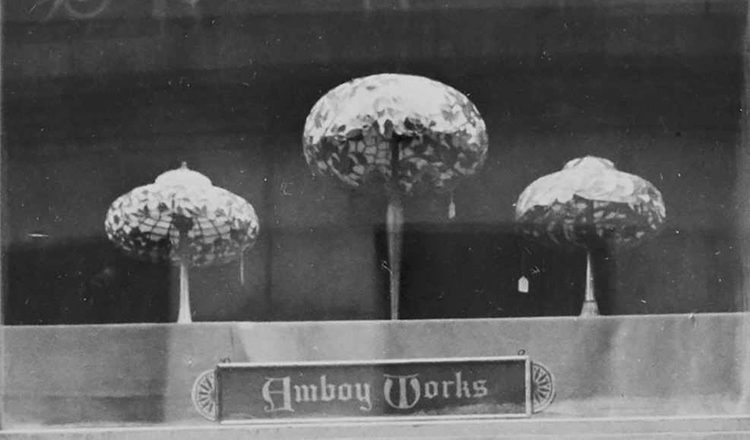
As the original images were of pretty high quality, it was possible to extract areas of particular interest.

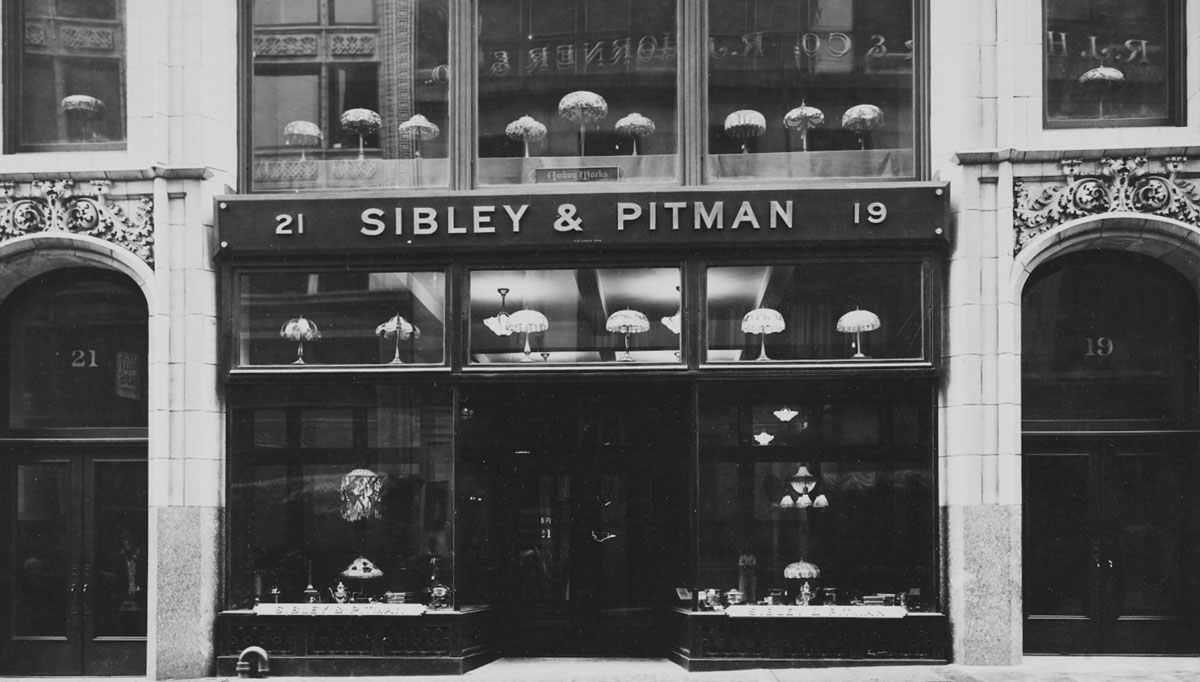
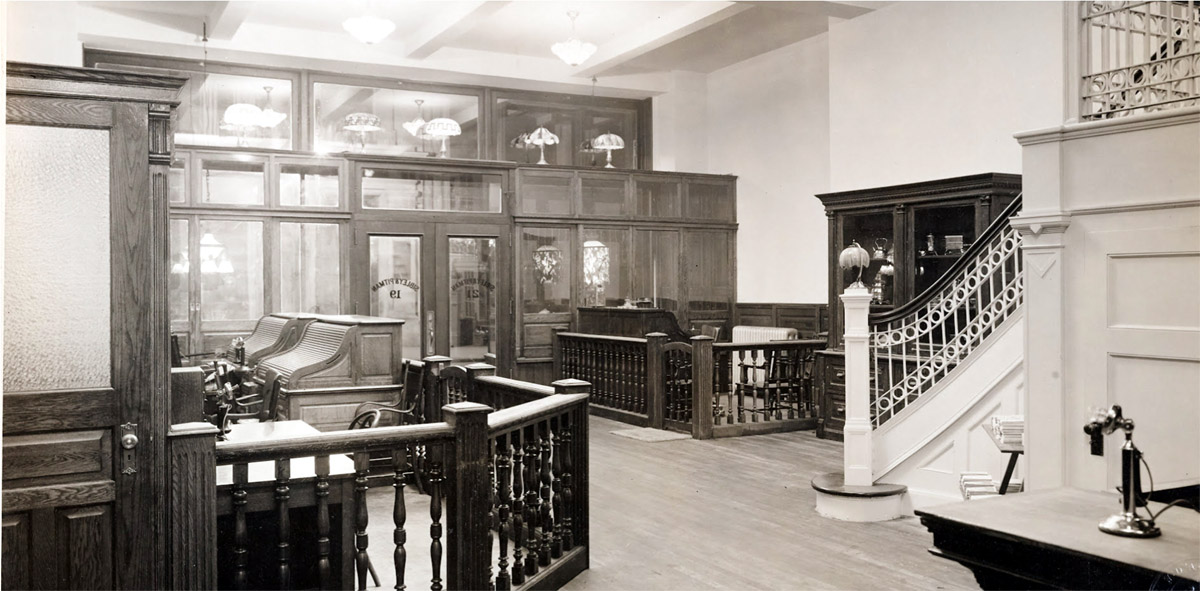



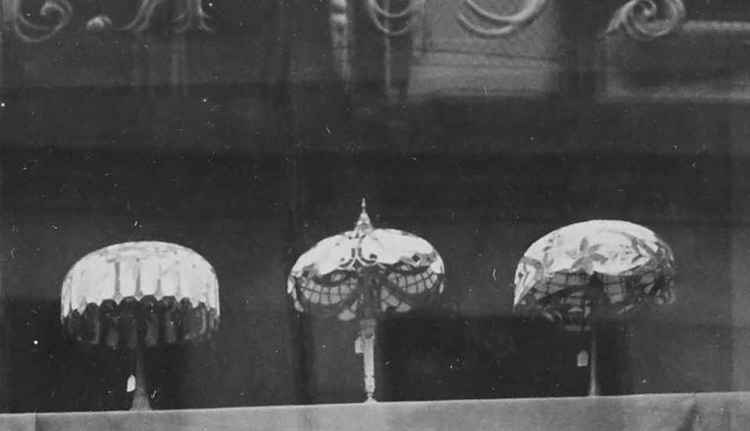
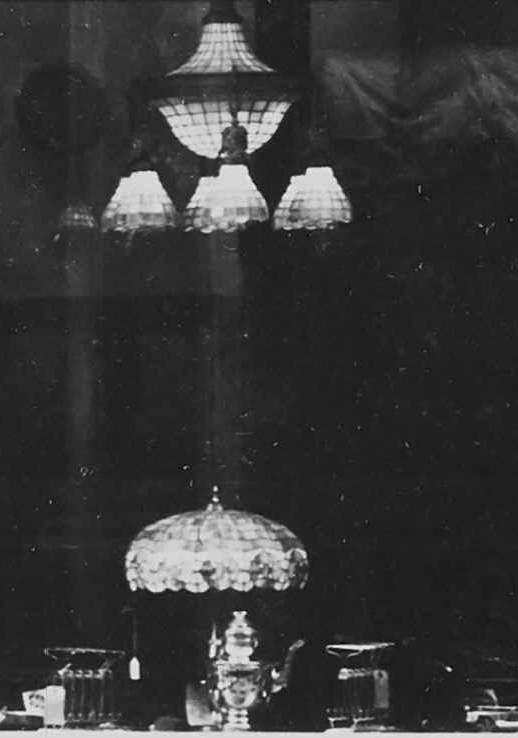
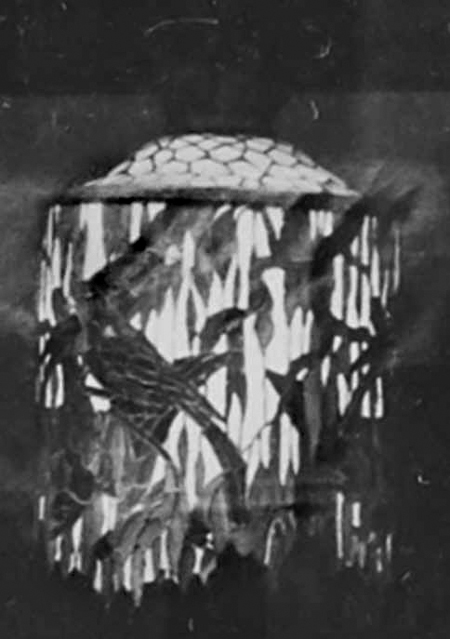
- S&P Showroom, 19-21 W.36th Street, NYC Image Copyright © miSci
- Showroom, 19-21 W.36th Street, NYC Image Copyright © miSci
- Showroom, 19-21 W.36th Street, NYC Image Copyright © miSci
- Sibley & Pitman Showroom Lamps.
- Sibley & Pitman Showroom Lamps.
- Sibley & Pitman Showroom Lamps.
- Sibley & Pitman Showroom Lamps.
- Sibley & Pitman Showroom Lamps.
- Sibley & Pitman Showroom Lamps.
- Sibley & Pitman Showroom Lamps.
Amboy Works
In January of 1906, Sibley and Pitman purchased the Old Music Hall at 183 High Street in Perth Amboy and had engaged Waldo Chapman. His engagement was later borne out by a press article 2 months later. Clarence Sibley became President of Amboy with a substantial investment of $50,000.

This image shows the extent of the capabilities at Amboy Works. This was a Sanford map dated 1908.
Interestingly, the next published map in 1914 showed significant changes had taken place, reflecting Clarence Sibley's sale of the main building to the Water Department a year earlier, and the focus of the remaining lamp business to be bent glass.;
Records show that in early 1907 Chapman was promoting his own Company, The Chapman Company in Boston. Chapman advertisements in life-style magazines were already in place targeting retail buyers for his lamps as early as March of 1907. This indicates that his continued presence in Perth Amboy was short lived even though the business relationship with Reed & Barton appeared to continue via Chapman, Rand Co. There is much still to discover regarding the shade making firms of this short period.

Newspaper articles and ads give insight into the scale of the operation at Amboy Works. Amboy frequently advertised for manufacturing staff from May in 1908 and this continued well into 1912, a long run. 29 male workers demanding better wages were swiftly outmaneuvered. Within days of the strike, a well publicized article reports that the company started recruiting trainee female help as replacements in the manufacturing area. Labor issues were not unique to Amboy, virtually all manufacturing firms faced growing discontent in working conditions by their staff.
Labor issues aside, Sibley's optimism for future growth of the leaded shade business appeared justified. Within the next few years, the King Street works was expanded yet again to include a brass foundry and plating and refinishing department. From mid-1909, advertisements in the press announced these capabilities to attract outside firms. This may have indicated excess capacity within these departments.
The last newspaper report in 1925 is of their bankruptcy. Sibley and Pitman continued to make and sell assorted electrical goods including fans and heaters well into the 1930s.
Established in 1906, Amboy Works was probably Perth Amboy’s largest shade manufacturer. The company’s early success was, as mentioned, driven by the vision of Waldo Chapman, a gifted designer who not only led the facility’s construction but provided its initial creative direction. This operational strength was further enhanced by the financial ownership of Sibley & Pitman, a prestigious New York agency.
By 1913, Amboy Works had maintained an 8 year run of production.
It is important to note that both Sibley and Pitman and Amboy Works existed as affiliates. S&P appeared to part sales agents and part manufacturers drawing upon small manufacturing concerns to support their broad line of electrical accessories. Amboy Works, was clearly one of these manufacturers. Amboy shades were certainly paired with R&B bases, yet not exclusively so. Significantly, their shades will also be found on bases of their own manufacture.
While Chapman was at S&P designing many of the shades for Reed & Barton, and are very typical of his later work in Boston, there are numerous examples of designs that bear little resemblance to his work at all. The S&P photos from 1913 are a full 6 years after Chapman left to start his own firm in Boston and it's probable that another designer over time was brought on board. So, research is ongoing in this regard.
New York and Clark Art Glass
Sibley’s position as President of Clark Art Glass in New York City, during the peak years of Amboy Works production is a point of interest. The brothers successful role as sole agents for Unique (see Mosaic Shades, Volume II) was terminated in 1909 just as Sibley & Pitman were enjoying success with Amboy Works. The precise nature of his relationship with the Clark brothers clearly warrants further research as the likelihood of some transition or deeper connection seems certain.
Summary
It is important to note that both Sibley and Pitman and Amboy Works existed as affiliates. S&P appeared to part sales agents and part manufacturers drawing upon small manufacturing concerns to support their broad line of electrical accessories. Amboy Works, was clearly one of these manufacturers. Amboy shades were certainly paired with R&B bases, yet not exclusively so. Significantly, their shades will also be found on bases of their own manufacture.
While Chapman was at S&P designing many of the shades for Reed & Barton, and are very typical of his later work in Boston, there are numerous examples of designs that bear little resemblance to his work at all. The S&P photos from 1913 are a full 6 years after Chapman left to start his own firm in Boston and it's probable that another designer over time was brought on board. So, research is ongoing in this regard.
Sibley's relationship with Clark Art Glass together with the Clark brothers' vital role in the success of Unique (See Mosaic Shades Volume 2) may yield further surprises. More on that possibility as research continues.
Amboy Works - The New Attribution
There is little question that most, if not all of the shades in the Reed & Barton archive and those in the S&P showroom were made at the Amboy Works. Chapman was the designer of many of these. Amboy Works got started in early 1906 when Chapman came on board. In addition to getting the firm up and running, he designed many of their shades. While his tenure there was short, his designs were still clearly being offered as late as 1911 years after Chapman had declared bankruptcy in Boston.
It is fully expected that as research continues, additional discoveries will require us to modify this position.
Identifying Showroom Examples

By the time the 1913 photos of the S&P showrooms were taken, years of lamp production had passed. Here are three fan / shell style shades that feature in the Sibley & Pitman offices together with another, an impressive lamp in the Egyptian style model clearly displayed in their showroom. This shade appeared at auction in 2020.
As borne out in the press, Amboy Works was fully equipped to make leaded lamps including the bases too so this company may have been responsible for the lion's share of the Gorham attributed shades, despite a small number of Gorham signed bases that we have seen over the years.
While it's possible that continued research into Gorham will uncover evidence of in-house shade production or use of an outside firm, for now at least, this appears more doubtful.


With what we have presented, there will be a necessary re-attribution of certain Gorham models on this website where the archive evidence justifies it. It may prove difficult to resist the current practice of attributing lamps with tiny apertures to the firm of Gorham.
The case for Re-Attribution
Image citation: Large illustrated catalogue, lamps and shades. Reed & Barton records, Volume D-20, Baker Library, Harvard Business School. Photographs courtesy of Peter Lyons.
This gallery shows a pairing of some lamps on this website (top image) that mostly carry attributions to Gorham and that are now proven otherwise by their appearance in the archive (bottom image). Now that we know for sure they are the work of Amboy Works, they will be among others that over time will carry the new attribution."


